

New research raises concerns over ‘substitution by stealth’ as global nursing shortfall grows
Major new research published in the September 2026 edition of The Lancet Public Health has put a number on the global Community Health Worker workforce for the first time, estimating it at 7.6 million. While recognizing the essential contribution of Community Health Workers, the findings raise concerns that they may increasingly be used as a substitute for more highly educated and skilled registered nurses.
The study also provides a new and starkly higher estimate of the global shortage of nurses and midwives. Researchers calculated that the world needs an additional 23.9 million nurses and midwives to achieve a score of 80 out of 100 on the Universal Health Coverage effective coverage index.
This compares with a previous estimate of 5.8 million missing nurses, which was based largely on existing health systems and patterns of care.
ICN CEO Howard Catton said the higher figure should not be interpreted simply as another measure of the workforce shortage. It reflects greater global ambition to expand access to effective healthcare.
“If we are more ambitious about global health, and serious about extending access to quality healthcare to everyone, that will inevitably require more nursing care and interventions. The world’s ambition for improved healthcare cannot be separated from investing in nursing.”
An uncomfortable truth
In its coverage of the study, Nursing Times interviewed Mr Catton, who described Community Health Workers as “hugely valuable and important,” while identifying a troubling global trend.
“The uncomfortable truth may be that, at the same time that we have seen high-income countries actively recruiting registered nurses, including specialist nurses, to address their own shortages, the replacement strategy in the countries that are losing registered nurses is to rely on Community Health Workers.
“This report highlights a replacement strategy which has not been obvious before. It is substitution by stealth.”
The study found that Community Health Workers were much more prominent in South Asia, Latin America and the Caribbean, Southeast Asia and sub-Saharan Africa than in high-income settings. In South Asia, they outnumbered nurses.
The researchers warned that the prevalence of Community Health Workers in lower-income countries could be “a marker of system-level shortfalls, where CHWs serve as low-cost labour substituting for more skilled workers.”
Mr Catton stressed that Community Health Workers have an important role in bringing essential services closer to communities and should be supported and valued. However, they must complement registered nurses and other health professionals rather than replace them.
An illogical paradox
The challenge facing health systems is not simply that more people need care. Patients increasingly have multiple conditions and more complex health needs, while the range of available treatments and interventions continues to expand.
Mr Catton said this creates an “illogical paradox”: at the very time patients need greater clinical expertise, some health systems may be responding by increasing the proportion of the workforce with less extensive education and training.
“It is an illogical paradox to respond to increasingly complex healthcare needs by weakening the overall skill mix of the health workforce. Community Health Workers make an enormously valuable contribution, but they cannot be expected to substitute for registered nurses with the education, clinical expertise and professional judgement needed to manage complex care.
“This is about far more than filling vacancies or increasing the overall number of workers. Health systems need sufficient numbers of people, but they also need the right combination of skills and expertise to deliver safe, effective care.”
He said the trend was particularly concerning when considered alongside the migration of registered nurses from countries that already have severe workforce shortages.
“Different metrics all point to the same glaring problem: the world does not have enough nurses. This is putting lives at risk while leaving nurses overstretched and burnt out. We need more robust, long-term workforce planning that recognizes nurses as an investment, not a cost.”
More than a numbers game
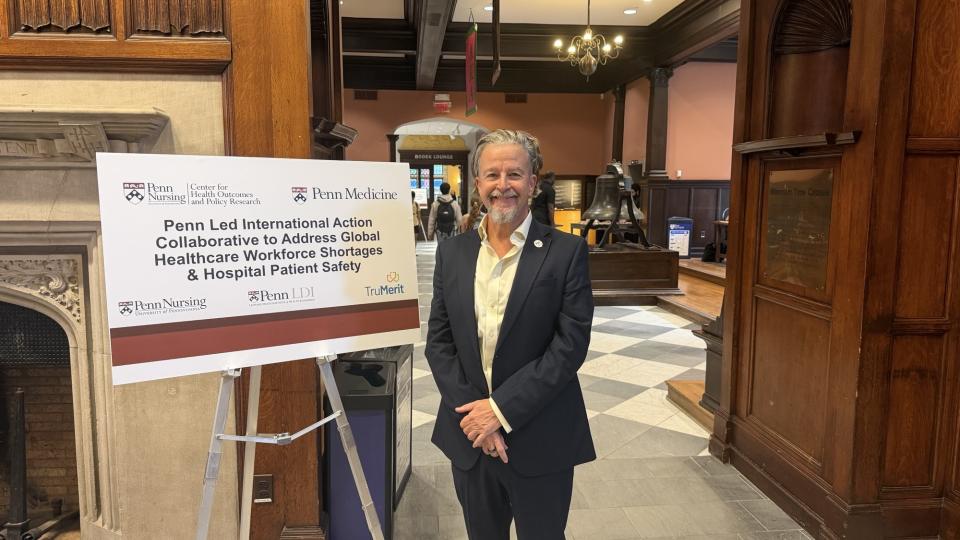
The importance of working conditions, nurse retention and the right skill mix was central to discussions at an event hosted by the University of Pennsylvania’s Nursing Center for Health Outcomes and Policy Research on 18 September.
Mr Catton joined nursing leaders and researchers to discuss how better working environments can improve nurse recruitment and retention, reduce burnout and strengthen patient safety.
The symposium highlighted evidence from international, nurse-led interventions based on the principles of Magnet recognition, which support professional nursing practice and create working environments in which nurses are able to provide their best care.
Research led by Professor Linda Aiken and colleagues at the University of Pennsylvania has repeatedly demonstrated that patient outcomes depend not only on the total number of health workers, but also on their education, expertise and working conditions. A lower proportion of registered nurses in the skill mix is associated with greater risks of patient harm and death.
Mr Catton said: “The evidence is clear that workforce planning cannot be reduced to a numbers game. Decent working conditions are vital if we are to recruit and retain nurses. But the skill mix also matters profoundly. Fewer registered nurses and a lower nursing skill mix mean a greater risk of harm to patients and, ultimately, avoidable deaths.”
Bridging the gender gap
The Lancet report, Measuring the composition and availability of human resources for health by sex in 204 countries and territories, 1990–2023, and workforce gaps for universal health coverage, also provided data on another major workforce imbalance: the gender gap.
It found that women predominate in nursing, midwifery and Community Health Worker roles but remain underrepresented among doctors. The researchers estimated that 80.7% of nurses globally were women.
Even within female-dominated professions, the report noted that barriers to women’s leadership deprive health systems of talent and can result in workforce strategies that fail to reflect the challenges faced by a largely female workforce.
Empowering nurses as leaders within health systems and policy-making will be key to addressing these structural problems and ensuring more women can reach their full potential within this highly skilled profession.
ICN’s Global Nursing Leadership Institute™ has helped more than 450 senior nursing leaders from around the world strengthen their ability to influence policy, with a focus on global priorities including gender equality.
The findings reinforce ICN’s call for governments to adopt long-term workforce plans that expand nursing education, improve working conditions, retain experienced nurses and protect an appropriate skill mix across health services.
Achieving Universal Health Coverage will require greater investment across the health workforce. But greater ambition for global health must be matched by investment in the highly educated nursing workforce needed to turn that ambition into safe, effective care.